[Review by Ritter and Galen]
Camping: isn’t it great? Wouldn’t it be even better if you could do it… in space? And wouldn’t it just be the bee’s knees if you could also… teleport everywhere?
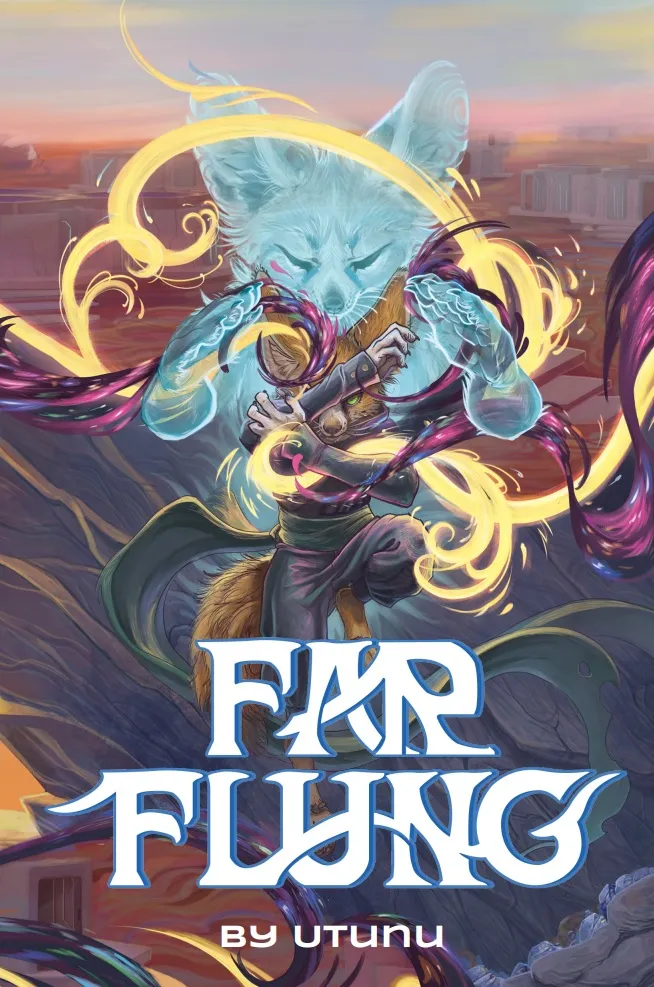
Such is the life of Bori, Tuther, and Samna, three friends in the desert colony of Sands. Bori and Tuther are fennecs, and like a lucky few of that species, they’re… gifted? gengineered?? (It’s not quite clear. Let’s go with…) endowed with psionic powers. These take a wide array of forms: most notably teleportation and telepathy, each with a few different iterations, and every individual has their specialties. Samna, by contrast, is a hyena, a species without any psionic…endowments. But he does have the advantage of being Large. (And as a short person, Ritter reassures us: tall people are a godsend.)
Samna is the tinkerer and science-nerd of the group, while Bori and Tuther do assorted tasks for the colony. The colony is in desperate need of rare minerals, and this is their all-hands-on-deck priority. Only one thing for it. We’ve got to go camping!
A lot. Like, seriously. There’s a lot of camping.
These moments stay compelling, both for the characters and for us as readers. Bori, Tuther, and Samna share a profound bond, and they desperately want as much time with each other as they can get, particularly since they’re up against a ticking clock: the dreaded colony shuttle-cum-aptitude test that will reveal Bori’s teleportation talents, and whisk him away to another planet, leaving Tuther and Samna behind. It’s a deeply charming, fascinating relationship, especially as the connections between the three of them develop and strengthen over time.
Tuther has also been displaying psionic aptitude, mostly in the form of telepathy and “disguising” psionic traces; he’s reluctant to disclose this to anyone outside his bubble, as he doesn’t want to be commodified and packaged off according to the whims of his society. So the master plan is for him to develop his powers to the point that he can “dampen” Bori’s psionics and make him look boring enough that the testers will leave all of them alone so they can get back to their camping trips.
Far Flung’s narrative ambles gently along its defined path, unconcerned with burdening the reader with heightened crisis and anxiety—until it does. The dreaded aptitude test hovers over the narrative like a rain cloud in the desert: yes, it will come eventually, but it will arrive more or less at its appointed hour, by which time we shall be safely tucked indoors, and until then, isn’t the sunshine great? The first few chapters, until we understood the game Utunu is playing, we kept turning the page expecting something absolutely horrendous to happen, and then feeling slightly foolish when it didn’t. It took us a while to trust Utunu to tell us the kind of story he wanted to tell, but when we did, it opened up the heart of the novel. Because it is, at its core, a novel about trust.
The story of these three creatures is defined by a gradual opening-up: trust lets them explore and learn about themselves in the kind, warm presence of one another; its absence forces them to diminish themselves in public. That same trust, and the vulnerability that comes with it, plays a major role further on in their relationship, where Tuther’s partners allow him to literally reach into and tinker with their brains while they’re sleeping. He (like the author) has proven himself to act responsibly and without malice, and so he can be trusted with that degree of power over their personhood. And the results prove to be good: they unlock an aspect of Samna that helps him do the thing he loves (i.e. engineering and research), and lets Bori embark on hours of training without exhaustion. These powers are potent, dangerous things, but the warmth that the book works so hard to develop allows us to lean on them without fear.
And the cosmos of Far Flung is, ultimately, a comforting place. One has the sense that intimacy, trust, and warm space cuddles are the natural order of things. Yes, community often falls short of that ideal: both their homeworld Sands and the distant planet Verdant are in the bad habit of making unilateral demands on their citizens, in large and small ways.
But it’s these failures that are treated as exceptional–anomalies that need an explanation. And the explanation offered by the book is the “Scar”: the wreckage of the original colony ship, and the crater it left behind. Note the name assigned to it: not the Crater, or the Wreck. The Scar, a name that is first and foremost about trauma, and wounds that don’t quite heal. In one of the most haunting scenes of the book, our three protagonists explore that wreckage, and the ghosts they find there (both metaphorical and literal) lay bare the pain that still lives in Sands and guides the choices of their leaders: pain which has eroded their hopeful society of mutual trust. That desperation, over time, has led to a society that is less a supportive network for its members, and more a demand that they all be cogs in the machine.
The slow, gentle first half of Far Flung above all shows us a healing process. Each of the characters, in their own way, has been isolated by the trauma at the heart of their community. This is a book about the time it takes to come together again, to build and rebuild trust, and discover in one another what we thought we’d lost.
It can take a while to fully understand the stakes of what the main three are undertaking together. Their act of healing is a soft, quiet thing, and Utunu doesn’t undermine it with flashing lights or pointless shoot-em-up action sequences. “Far Flung” is in the end an adventure story, but when the peril arrives, it meets a trio that has already done the work to discover where their strength really comes from.
“Far Flung” can be purchased in print or as an ebook.
Print: https://mapakuvillage.square.site/product/far-flung/3
Ebook: https://mapakuvillage.square.site/product/far-flung-e-book-/4


Leave a Reply