(Part 2 of the Endless Forms Most Beautiful essay series. Part 1 here.)
As a matter of taste, I’d like to ask this question in an inside-out kind of way. That is, I don’t want to start with big demographic surveys (not least because the extremely cool folks over at FurScience have already done a fantastic job). Nor is my approach going to be a large-scale history tracing the development of the community over time (not least because the extremely cool folks over at Fang, Feather, and Fin have done an equally fantastic job).
Rather, I want to start small. Like exploring a new planet by putting a grain of sand under a microscope, or sitting with a single flower long enough to find the deep secrets of biology. My hunch goes like this: if we’re such a weird, interesting community on a large scale, maybe it’s because we’re brought together as individuals by weird, interesting forces.
And if you really want to dig into this in a fundamental way, and truly fathom the depths of the furry heart, I think one question presents itself before all others.
Why is this mop so mad at me?
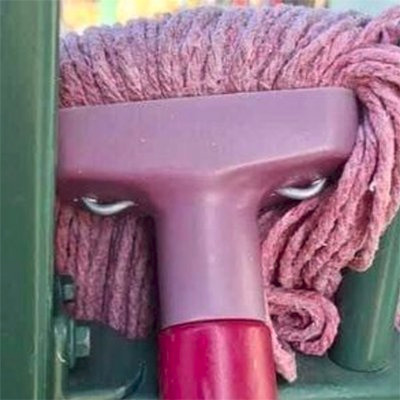
Apparently I’ve said something really offensive to the cleaning supply and housewares community. Oops.
This is actually pretty cool, right? ‘Pareidolia’ if you’re being technical, but you don’t really need formal language here. Humans have a real flair for seeing people and especially faces in unexpected places. I doubt I’m the only one here who managed to jumpscare themselves with a pile of dirty laundry when they were sneaking through the public spaces at 2 am with the lights off.
I like starting here because it’s so simple. There’s no intent behind it, no artist trying to draw out the human-like qualities or anything like that. It’s an accident of design–just you, a mop, and a brain that’s incredibly eager to anthropomorphize the world around it. The atomic unit of the furry world, so to speak.
Sit with this mop for a while and you’ll notice a couple interesting things about what your brain is doing…
First, it’s pre-rational; you see the face very fast, maybe even before the word ‘mop’ enters your mind at all. In other words, anthropomorphization is a process that we do by reflex, less like deliberate artistic creativity and more like the way that we pull our hands back from a hot stove.
And that’s no accident! Faces are so important to human survival that we’ve literally got a physical chunk of our visual cortex dedicated to recognizing them–the fusiform face area (if you want something to memorize so you can sound fancy at parties). It’s towards the back of your head, right behind the ears. That’s one reason why it’s so hard not to see the angry mop, just the same way that it’s hard to see a collection of lines instead of a triangle. Recognizing faces (and the emotional and social information they carry) is one of the truly primitive operations of your brain, far too important to be left to the conscious mind.
A second interesting thing is, you can tell that there’s a direct match between the image of the mop and particular features of a face. It’s not just a general face-ish vibe. There’s the metal loops standing in for eyes, the bristles as hair, the horizontal brow and vertical nose, the thin line of a mouth where the socket meets the handle. In other words, anthropomorphization is taking place not because of one single feature that’s a close match to humanity, but because several different simple shapes happen to be in about the right place relative to one another.
There’s a good-enough-ness to it, a willingness on the part of your brain to fudge the correct ratios and convince itself that it’s looking at a person. Cartoonists and caricaturists have been taking advantage of this since forever! We can massively distort the human face in visual art and still come out with something recognizable.
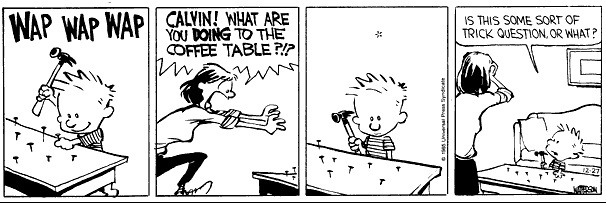
CALVIN AND HOBBES © Watterson. Reprinted with permission of ANDREWS MCMEEL SYNDICATION. All rights reserved.
Take another look at this thing, for example. Calvin’s face is crowded entirely into the bottom half of his head, giving him a giant forehead (the better to scheme with, one assumes), and the head in turn is massive in proportion to the body. Eyes, nose, ears, and mouth are all basically just a single line each, with clear shapes but absolutely no detail.
Calvin is, more or less, a mop.
And this works fine, right? Better than fine, even. Calvin’s visual design in this strip helps the gag land, it’s not just a way to cut corners. Bill Watterson knows that he can trust our brains to fill in the gaps here. And when a skilled artist chooses those simple lines with intentionality, the illusion never collapses the way it does with the mop! When you read that comic, you’re doing something much closer to imagining a person than you are to seeing a person, but it’s such a deep-seated part of how your brain works that you don’t usually notice the difference.
Take a moment to sit with this a while. See if you can actually force yourself to see the lines that Calvin is made of, it’s kind of a neat exercise. Double vision: the person and the mop.
Personally, I get to wondering. Why is our facial recognition algorithm so…‘lazy,’ for lack of a better word? When you actually look at the lines that Watterson uses for Calvin, they look hardly anything like a human face–the spacing between the eyes is just tiny, the mouth is either way too small or way too large, the nose is just some kind of rounded cylinder sticking straight out of his head. Bill didn’t need to make that nose even a little bit triangular to get our brains to pick up on it.
And from an evolutionary, biological perspective, isn’t it a little weird to have a bunch of monkeys with brains tuned to occasionally jumpscare them with imaginary faces? Is it really that hard to tell a real face from something like Calvin’s loose geometry? From a mop, or a pile of dirty laundry at 2 am? Sure, this stuff needs to operate quickly, and maybe it’s worthwhile to sacrifice a little accuracy in the name of speed, but come on.
So let’s widen our net a little…
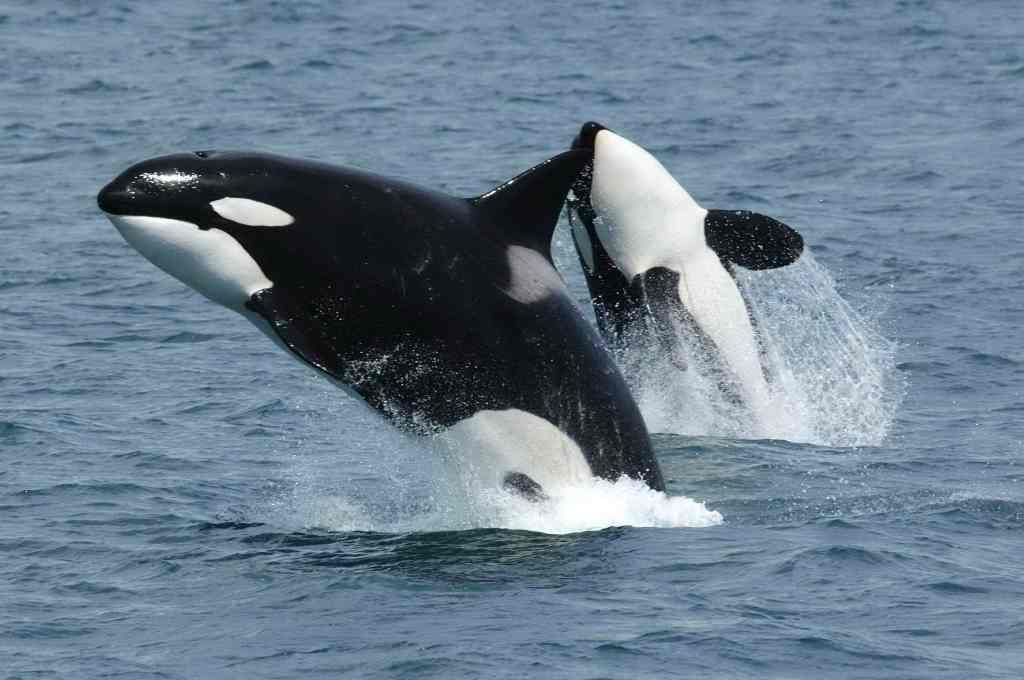
I’m not too embarrassed to admit that orca are constantly fooling me with this trick.
Like, it’s not that I believe the white spot is an eye exactly–though I think maybe I did when I was a little kid. But I just keep ‘seeing’ the face they want me to see, the same way that I see a face when I look at a comic strip or our mop. Best case, I get that double-vision like when I really sit with Calvin for a while.
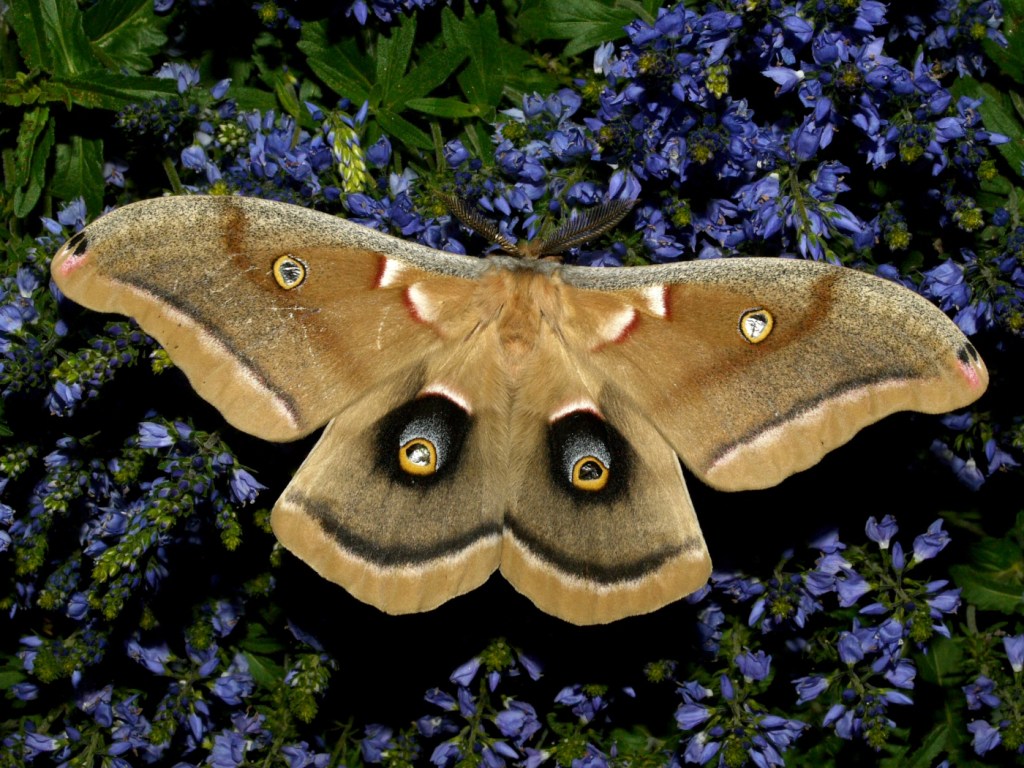
And this isn’t at all a rare thing to see in nature, either. Fake eyes abound, just as other forms of camouflage do. Tigers have that thing on their ears, there’s pandas and raccoons and other masked species, there’s the moths with big eye spots. All of them sketching out an imaginary face the same way that Bill Watterson did, with a cartoonish or even ‘stylized’ exaggeration, if you’re brave enough to use that word for a natural process.
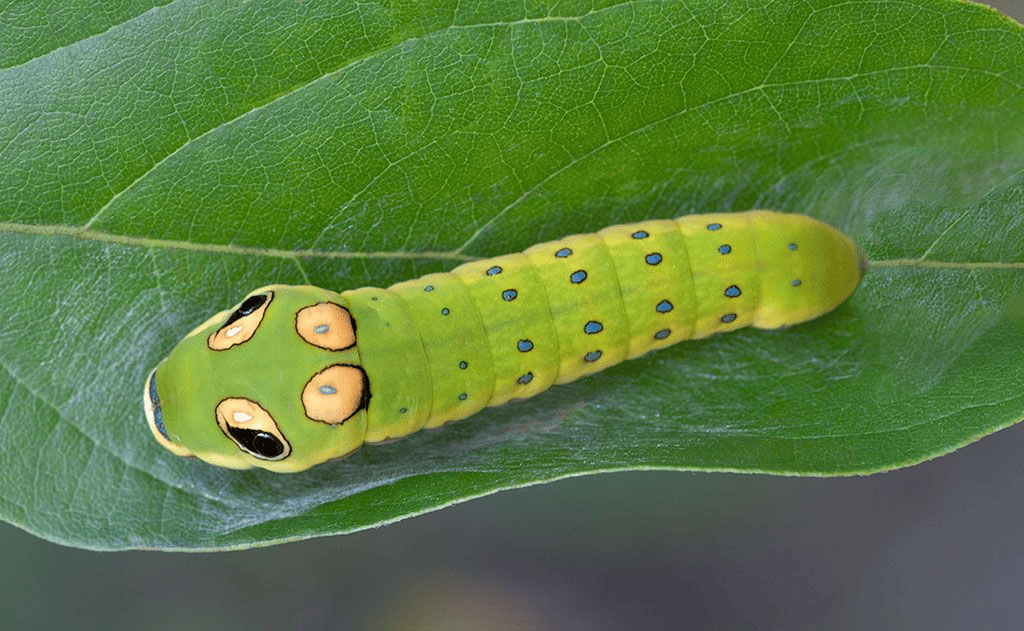
For any given species that does this, there’s usually a pretty good explanation. On insects, it’s likely meant to startle predatory birds (or in the case of some caterpillars, to imitate snakes); on predators like tigers, it can make them seem like their eyes are constantly alert or misdirect attacks during a scuffle; on birds of paradise, it’s runaway sexual selection. And so on.
But I don’t want to miss the forest for the trees. Step back a minute, and marvel:
The orca whale thing kind of works on humans. That’s freaky, right? Like, there’s a color pattern emerging from the crucible of evolution to do…whatever it’s supposed to do. Help orca communicate with one another, or protect their eyes from bird pecks or something. But whatever those reasons might have been, there’s no way that trying to confuse land-dwelling apes was especially high up on the list. There’s no shared environment at all! It’s kind of a fish! And yet!
And yet!
Here’s what’s so obvious that it’s easy to miss: ‘fake’ face markings like this are often about communication and deception between species, not within species. The caterpillars mostly don’t seem to be using their false faces to learn about other caterpillars; they typically use those markings to protect themselves, by triggering their predators’ own ‘facial recognition’ in unexpected ways. Same with tigers. The eye spots on their ears are positioned to pop up when they’re leaning down to eat or drink, so that potentially dangerous animals around them (tiger and non-tiger alike) won’t notice that they have an opening.
But of course, nobody bothers to paint a false face on themselves unless real faces already mean something. And if those false faces serve to communicate even between two very different animals, then surely the real ones do too! Facial features are a kind of common understanding, a pattern that crosses the species boundary. They act as a symbol that alerts many, many different organisms to the fact: “Hey! I’m an animal too, and I’m paying attention!” It’s that act of recognition—happening all the time, all through the fabric of nature—which mimicry like an eye spot is designed to exploit.
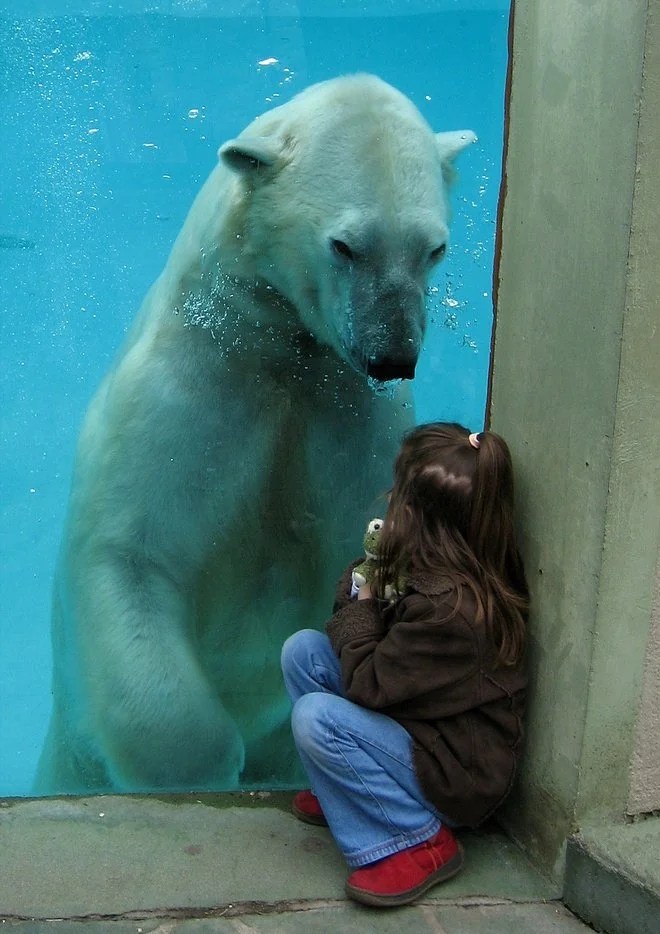
Photo by Jürgen Schmidt. Originally posted to Fotocommunity.de.
So I gotta figure, maybe the human facial recognition algorithm is so flexible (with lots of false positives!) because it’s not a ‘human’ facial recognition algorithm at all, in either sense. Facial recognition is not a preoccupation that’s exclusive to humans, nor is that part of our brain meant exclusively to detect humans. A great many animals in nature use the basic pattern of the face to recognize one another as fellow-animals, even across huge differences. Reptiles to birds to mammals to insects; predators, prey, pests, friends, companions, food. We can’t know exactly what our biological cousins will look like before we meet them, but if we see anything with even the loose contours of the face we’ve come to expect—even if it doesn’t match exactly to what we already know—then it’s not a terrible bet that there’s a brain lurking in there somewhere, too.
So let’s take another look at our mop one last time, with a slightly more satisfying perspective in-hand, and pay attention while our facial recognition patterns trigger. We know that the face-recognizing part of our brain extends far across any particular species boundary. It has to be flexible enough to recognize new and unfamiliar creatures as creatures, even pictures of animals that might just be imaginary. When it activates, this mental pathway primes us to expect something that may move unexpectedly and act independently, the way that animals do. We imagine not just an animal, but a mood, because it evokes an entity with agency, feelings, emotions, and maybe even a personality. We imagine a being that can be understood through creative empathy, by asking ourselves what it wants and what it will do to get it.
Turns out that the anthropomorphic illusion of a face here is both more and less than it seems: a trick of perception flexible enough that we can’t anchor it in anything that’s narrowly ‘human’ as such, but that nonetheless makes room for all the wonders of personhood.
And that distinction, I think, is the seed of everything that follows.
See you again in part 3!


Leave a Reply