(Part 3 of the Endless Forms Most Beautiful essay series. Start here.)
It’s funny, I began last section meaning to talk about anthropomorphization: adding human qualities to nonhuman stuff. But I started with faces, and it turns out that faces aren’t necessarily all that human to begin with! A face can be a much more enigmatic thing, a sign of agency and a mind even in new and unfamiliar creatures. It can take many different forms, many of them very in-human, and so our ability to recognize faces has to stay just as flexible.
It’s this very flexibility that furries depend on, you know? A coyote looks nothing like a lion, looks nothing like an alligator, but they’re all friends. And what’s more, there’s no standard formula, no one ‘correct’ way to draw an animal-person, even when it’s the same animal-person! Here are two portraits of me: the one on the right is by Storiel, one of my favorite active artists, and the other is a VRChat avatar that was rigged and sculpted by Tosca, with a little private touch-up to get the textures right.
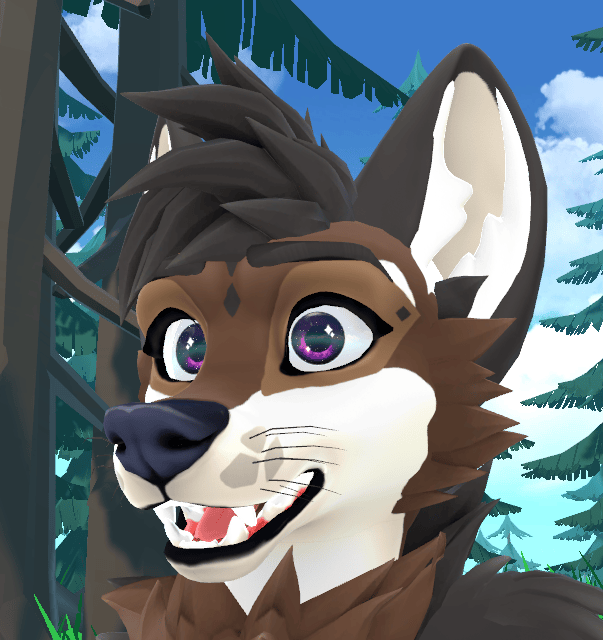
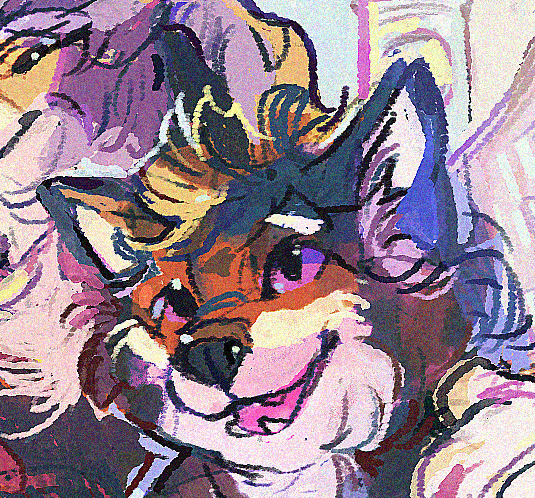
These are quite different, but equally valid ways of representing my (devastatingly handsome, I’m sure you’ll agree) face. In neither does the casual observer have any trouble recognizing a kind of personhood in these portraits, even though neither is especially human. It’s just kind of obvious to us that there’s a light on inside, right? And skilled creators like Storiel and Tosca can do this across any number of different animal species, even purely imaginary ones like dragons.
And now we have reason to suspect that this artistry isn’t as straightforward as it might seem, that it’s not anything as simple as making them ‘human’ in any familiar sense of that term. We quite naturally engage with faces as a multi-species phenomenon, not purely as a human one.
So here’s a head-scratcher: why do we reach for this word, ‘anthropomorphic’? Why not, say, zoomorphic?
It’d be equally correct, no? What we’re really talking about is a person with a mix of human and animal traits. ‘Anthropomorphism’ is the attribution of human qualities to nonhuman things. ‘Zoomorphism’ is the attribution of animal qualities to human things. When we choose the former, and not the latter, we’re doing something really interesting. We’re saying that the deep-down essence, the ground truth of a furry person, is that they’re a nonhuman being with a few human characteristics, as opposed to a human being with a few animal characteristics. We’re taking a mix-and-match continuum of human and animal properties, forcing it into a binary, and then identifying with the far side of that binary. This is a weird thing to do! And yet it feels so natural.
I’ve got a theory, if you’ll bear with me.
So let me tell you a story. This is a story about three robots, and what they mean to their audience.
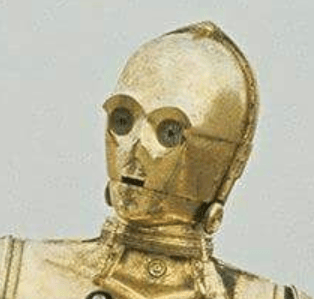
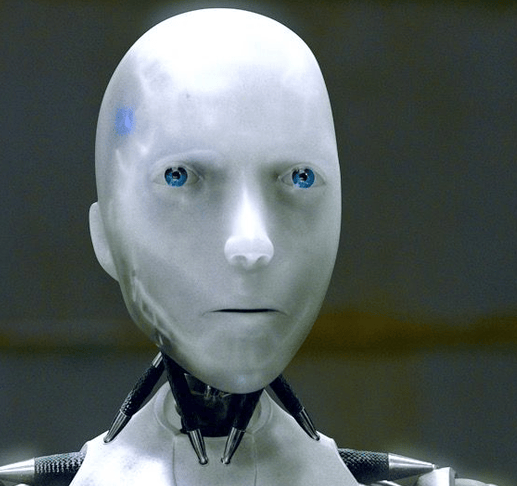
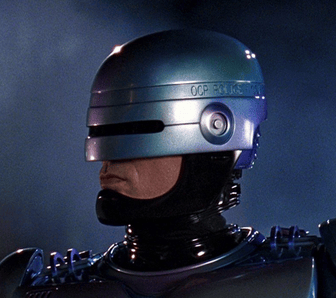
Image credits: Left, Star Wars: A New Hope. Center, I, Robot. Right, RoboCop
They are each pop-culture juggernauts in their own right: C-3PO of Star Wars fame, Sonny from I, Robot, and Alex Murphy from RoboCop. Pretty good odds you recognize at least one of these guys.
C-3PO plays a particular role in Star Wars, that of a sidekick and comic relief. His status as property–as an object outright owned by the protagonist–is never questioned, even though he is to all appearances an intelligent and even sociable being. When he’s torn to pieces in one film, we laugh. And of the three robots, you’ll notice that C-3PO’s face is almost completely nonhuman. Thanks to our super-flexible capacity to see faces, his design didn’t need much; a flat line for the mouth, a bare hint of a nose, a couple perfectly circular eyes in approximately the right place.
Just as Bill Watterson could use a more stylized face for Calvin as a way to help his jokes along, so too did George Lucas use the stylized face on C-3PO to allow audiences to treat the character ‘lightly’, appropriate to his role in the film. The visual language of a more abstract, less human face is a way to help the viewer think of C-3PO as something more like a pet or animal, rather than a peer to protagonist characters like Luke or Han Solo. And that sense of him as pet-like overrides even the fact that he speaks quite eloquently to us, as a human does.
Sonny, on the other hand, is in a film that asks its audience to think really deeply about his perspective. Is Sonny a person? Can he be trusted to act like one? Does he feel as we do? In many ways, his movie is about those questions. He’s taken seriously as a character, and his destruction is treated as a grave matter.
In contrast to the simplified geometries of Star Wars, the I, Robot film pushed its 2004-era technology to the limit to give us a nearly-human face, at least in its overall shape. There’s an alien-ness in tint and color, sure. And yes, the face is translucent, so the audience has to choose in any shot whether to focus on the mechanical shapes beneath the skin, or the soft, emotive surface. But that face, when we do choose to see it, is a strictly human one.
Officer Murphy, the RoboCop, is an interesting mix: in his mechanical pieces, he’s every bit as stylized as C-3PO, maybe even more so. The ears of his helmet are simple circles, the eyes are a single horizontal line, there’s only the barest suggestion of a nose in the way the helmet protrudes out over the mouth. But the lower part of the face, the mouth and cheeks and jaw? Strictly human, in the old-fashioned sense. It’s the only place on the whole character where a hint of the human being remains, at least when the helmet is down. Not anywhere else–not the hands, not the torso. Just that one spot.
And the film itself, aside from being one of the genre-defining shoot-’em-ups of its era, is about the fading and questionable humanity of Murphy as he’s resurrected into a killing machine. As with Sonny, the partial human anatomy is a visual shorthand for conditional human value and interiority, but in this story, Murphy’s humanity is vanishing into the mechanical systems all around it. A good story in its own right, but–how odd that, of all the parts of the body that might represent the last desperate flickerings of humanity, the movie settled on his mouth?
These three robots have something important to teach us! Yes, we can see (and even hallucinate!) faces in many different places, in many different shapes and patterns. But there’s something very strange about this particular part of the face, above and beyond the anthropomorphic tendencies of our mop.
You can find it easily enough: just touch your thumbs and index fingers to one another, forming a diamond shape between your hands. Hook the index fingers just over the bridge of your nose, and let the thumbs rest just under your chin. That’s it, that’s the Zone. And it is unfathomably important to the way you build a life in human culture. Once you start looking for this pattern, you see the Zone everywhere in media: the secret hinge of human empathy.
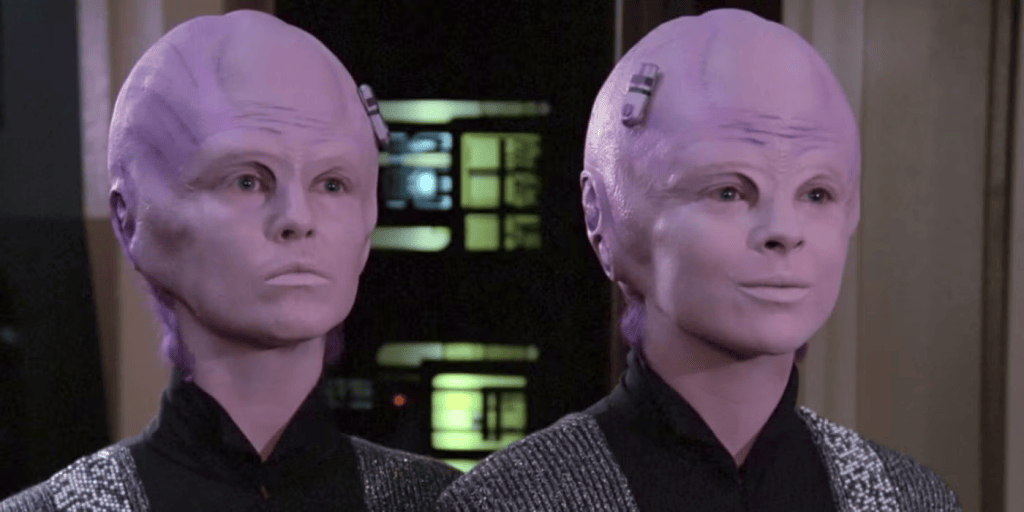
Image credit: Star Trek: The Next Generation
In sci-fi television, Star Trek is perhaps the series most committed to a positive vision of human unity and interspecies cooperation. It’s a unifying vision best seen in the Federation, a grand alliance of worlds. But it’s also the series most famous for costuming choices described (affectionately or otherwise) as ‘wrinkly forehead aliens’. In contrast to other settings, Star Trek aliens almost always have an anatomically human Zone, even when the costumes otherwise give them very exotic features or break the traditionally human silhouette. The Federation, it seems, is built on mouths.
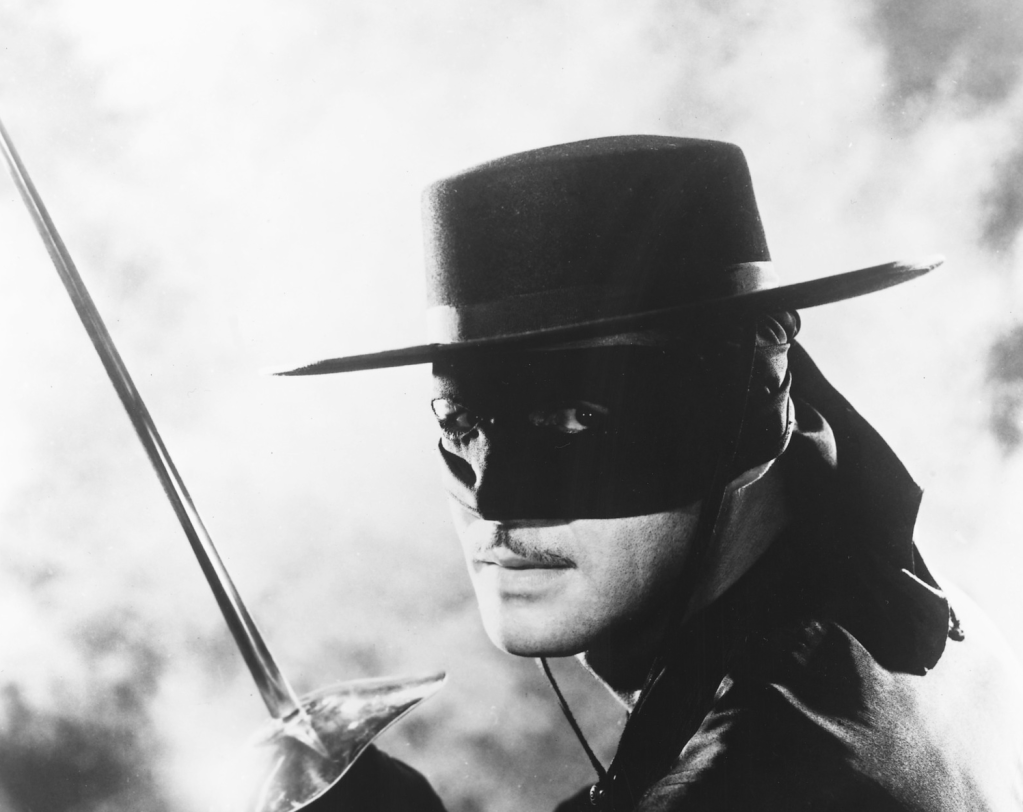
Image credit: Zorro (1957)
Or, consider superhero comics. Some, like Spider-Man, cover the entirety of their face; others like Superman go fully unmasked. But something interesting happens when the face is only halfway covered–heroes like Captain America wear half-cowls covering the upper part of the face, or sometimes smaller masks that just cover the eyes. But they hardly ever do the opposite, covering only the Zone and leaving their eyes free. Villains, on the other hand…
Whether silly or terrifying, Western comics seem to converge on this notion that evil can be expressed by the visual shorthand of a person covering their face from the nose on down. Often, the biggest difference between a villain and an antihero is just which part of the face is covered by their costume!

Image credit: Il Bandito Nero (advertisement), 1967
And this is an old, old tradition. I’m pretty sure they got it from cowboy westerns, among other places: the early 20th century image of the masked bandit. At the time, a ubiquitous American symbol of the easily dispatched goon, and still a powerful pop-culture tool even today. Probably a cattle rustler, definitely up to no good. Wanted dead or alive, probably dead. It’s easy to tell at a glance, right? Because of the bandana. Because of the Zone.
We could keep pulling examples all day, but I think you get the gist. Still, we’ve got to ask, why should this be? What’s so special about mouths, at least in the Western artistic tradition I’m interrogating here?
Honestly, I think there’s a sensible reason. Ask any actor, and they’ll tell you that doing their job under a full-face rubber costume is really hard. Without being free to use the Zone, it’s almost impossible to use facial expressions to communicate with your audience. And that’s because the lower part of the face is way more flexible and expressive than the upper half. Like most animals that eat to survive, human beings developed a lot of delicate articulation in the mouth area. And as social animals, we use that anatomical advantage to do more than just eat! We use it to communicate and share emotions as well.
Just as the tongue and lips help create a wide array of different sounds for language, we learn from a young age that the position and shape of the mouth can clearly express a wide array of different emotions. A smile for happiness, a frown for sadness, an open ‘o’ for surprise. The eyes and the rest of the body contribute, but when it comes to expressing your emotions, there’s really no substitute for the mouth. And so, in turn, the mouth becomes a visual shorthand for interiority, especially emotional feelings and personhood. To cover the mouth is to leave a world of feeling and enter a world of action, a place where the people around you judge you by the physicality of your body rather than your felt experience.
C-3PO has only a slot for a mouth; he cannot smile or frown. And so when he is disassembled for parts, it’s a funny gag instead of a horror scene. Even though C-3PO is undeniably a person, on some deep level the audience treats him as something less, and the Zone helps give them that cue. By contrast, RoboCop’s human Zone, preserved there among the robot parts, leaves us with a touch of discomfort and body horror. That face makes us aware that this is a character who might have felt something, and the flat affect makes the lack of those emotions feel like a loss or an injury. We read him as ‘more human’ than C-3PO, even though he’s far less emotionally expressive.
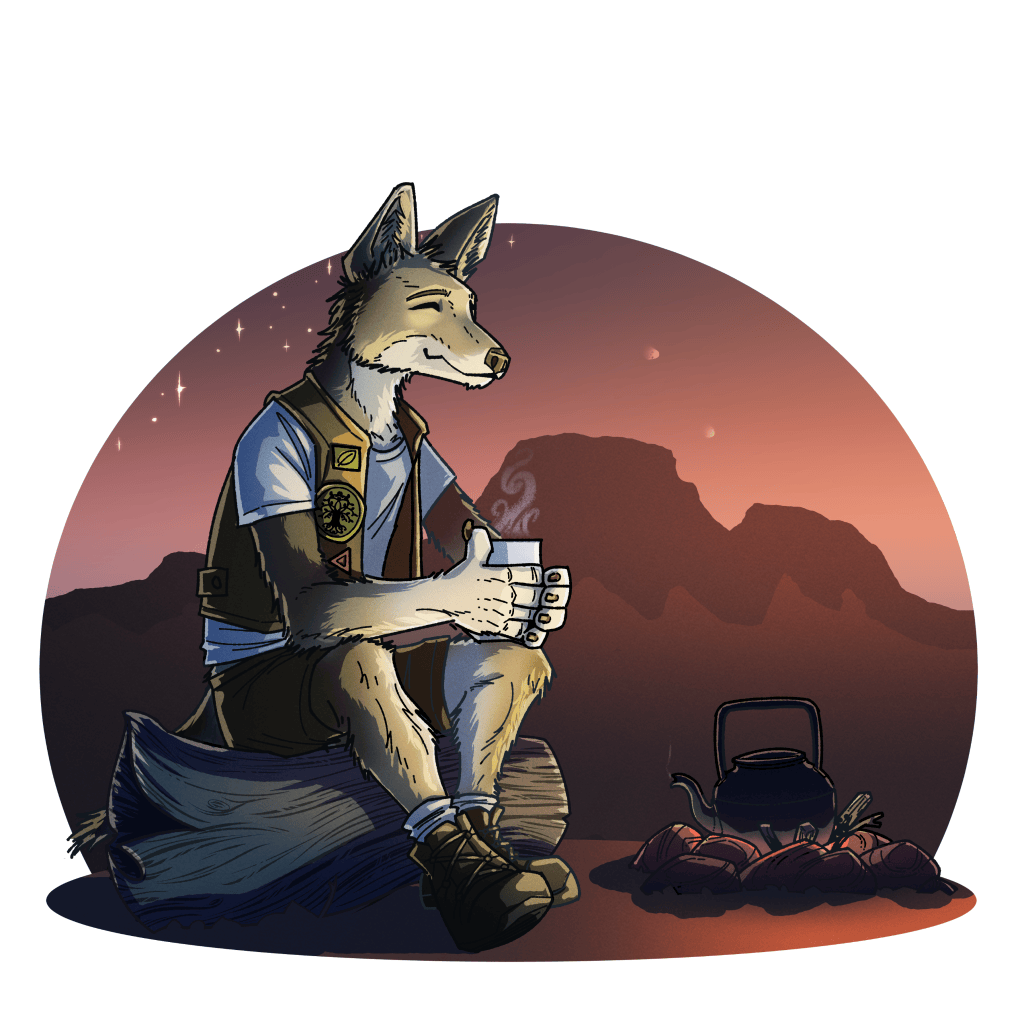
Art by Orin Oxide
All of which leaves you and me in a rather awkward place, right? On account of, we don’t have a Zone. Or at least not a human one.
Emotive, sure. Thanks to the sheer flexibility of our cross-species facial recognition, animal faces are more than expressive enough to share emotions with the best of them. But the Zone is as rigid as the face is flexible, even if it’s a more subtle factor. Without a carefully articulated Zone, even exaggerated emotional expression often lacks a certain weight: even in caricature and heavily stylized cartoons (which only imply the Zone rather than showing it) characters can suffer injuries that, in a more realistic medium, would be horrifying to watch. Calvin’s mop-like face is an invitation to laugh, even at his misfortunes.
Given the infamy of furries, it’s a curious fact that animal traits on a human being are quite popular. From catgirls to playboy bunnies, from angel wings to a devil’s cloven hooves, the human species has always used animal features to invoke play, sexuality, power, and magic. And this stuff is absolutely mainstream, often a part of ancient cultural practices or hugely popular media. It’s got appeal for the average person, is what I’m saying. So what is furry? What sets us apart, gives us our own sense of identity and community? Is it just a question of intensity, or is there a difference in kind lurking somewhere in here?
Catgirls, playboy bunnies, angels, devils–these ‘mainstream hybrids’ all have animal traits, but they usually have a human Zone, too. You can tweak the human body in any number of exotic directions, really. Blue skin, fox tails, horns; none of these disqualify you from full personhood. But messing with the Zone is a much more radical act than it might at first seem.
Mixing human and animal traits admits a wide spectrum of possibilities, and there’s no specific mix that’s more correct than any other. There’s a gradient from fully human on one side, to fully animal on the other. But thanks to role of the Zone in emotional communication, what might have been a smooth continuum has a huge, socially constructed chasm right down the middle.
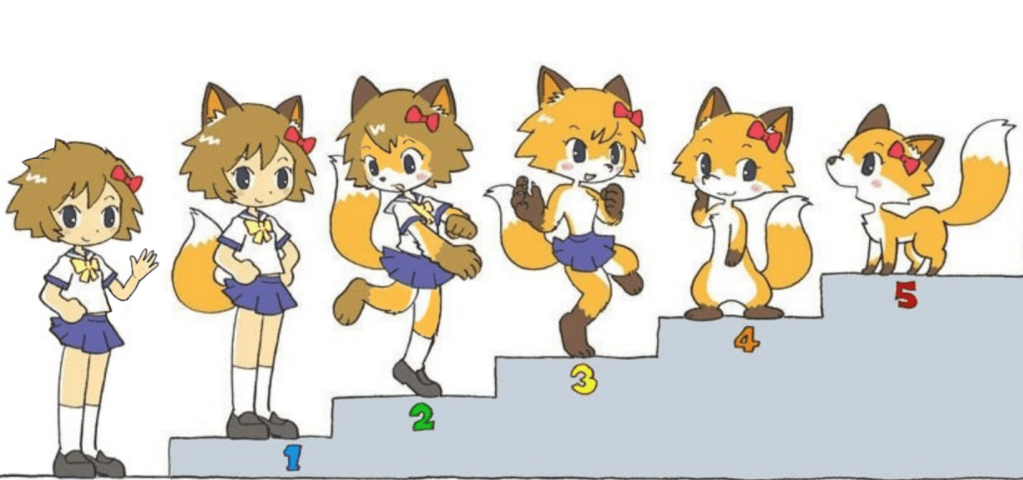
Image credit: かb
On one side of that chasm are the characters and costumes that clearly preserve the Zone, and with it the full range of factory-default human emotional expressions. And on the other side are the characters that disrupt the Zone in design and anatomy–with a muzzle, a snout, a cyborg faceplate, or anything else. The near side is usually received as a human who happens to have animal or alien traits. But the far side of that boundary becomes anthropomorphic, a nonhuman creature with human qualities. The limits of humanity are the limits of the Zone, right there in the diamond between your thumbs and your fingers.
And here’s our puzzle: the face in general is this massively cross-species phenomenon, capable of being understood widely across the natural world. But the specific contours of the Zone communicate moral weight and a sort of ‘full-status humanity’ that isn’t granted to the otherwise broad array of species that have faces. So where does that leave us as furries? We’ll chew on it next week, in Part 4!


Leave a Reply